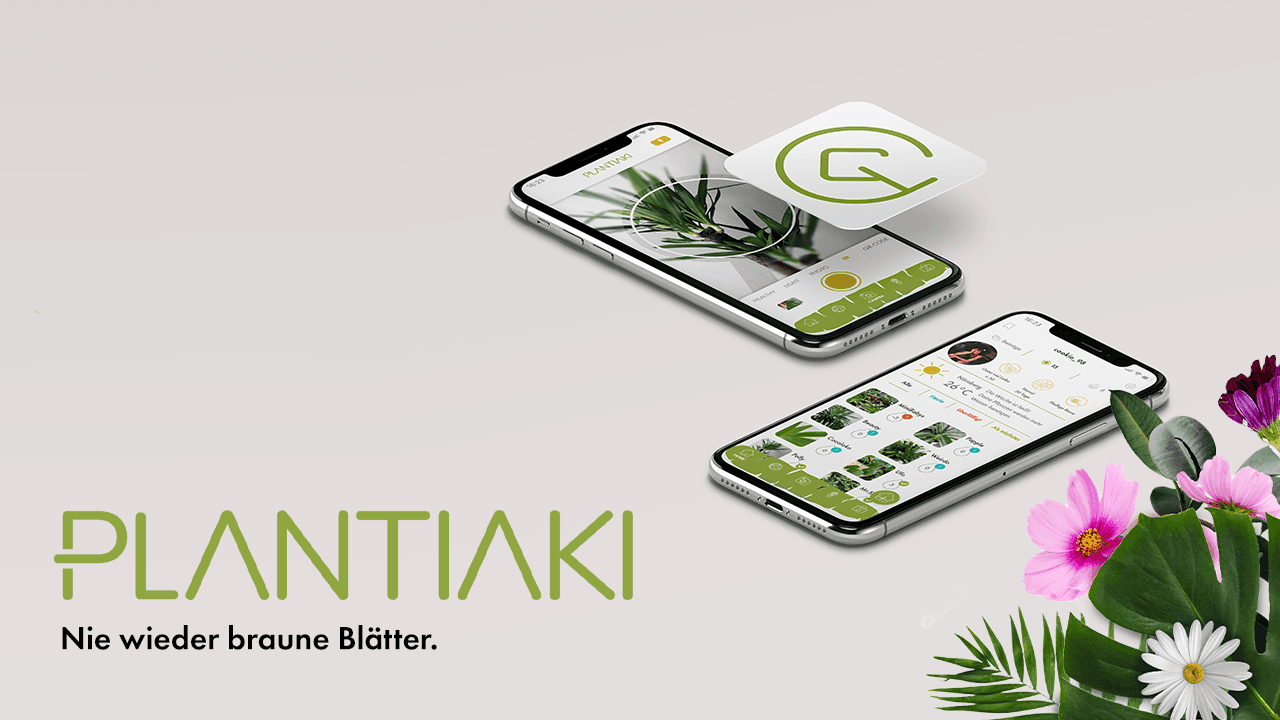
PLANTIAKI
App concept for sustainable plant care — born from personal failure. The bachelor thesis that landed me my first job as a Product Designer.
Overview
I've killed more houseplants than I care to admit. From that very personal failure came the idea for PLANTIAKI.
PLANTIAKI is an app concept for sustainable plant care — developed as a bachelor thesis in 2020. The app was never built. Yet it's one of the most impactful projects of my career: this case study landed me my first job as a Product Designer.
01 —Challenge
The Origin
Some projects grow from market trends; others from genuine frustration. PLANTIAKI belongs to the second category. If I was failing despite real interest — how many others felt the same?
The Question
How can active environmental protection be integrated into everyday life in a way that delivers real personal value — rather than feeling like yet another obligation?
Studies show that over half of all houseplant owners have accidentally killed an average of five plants. Nearly half say they're fundamentally unsure whether they can keep a plant alive. My own survey of 100 participants confirmed and deepened this picture.
02 —Users & Insight
Understanding Users
To truly understand the target audience, I surveyed 100 people from all walks of life. Five key statements directly shaped my personas:
- "I want to live more sustainably but don't know how."
- "I want a green thumb — all my plants keep dying."
- "I use my phone four to six hours a day."
- "I catch myself not keeping my environmental promises."
- "I'm ready to change my behaviour to help the environment."
Together, these paint a clear picture: the motivation is there, but self-discipline and knowledge are often missing. And the smartphone is always within reach anyway.
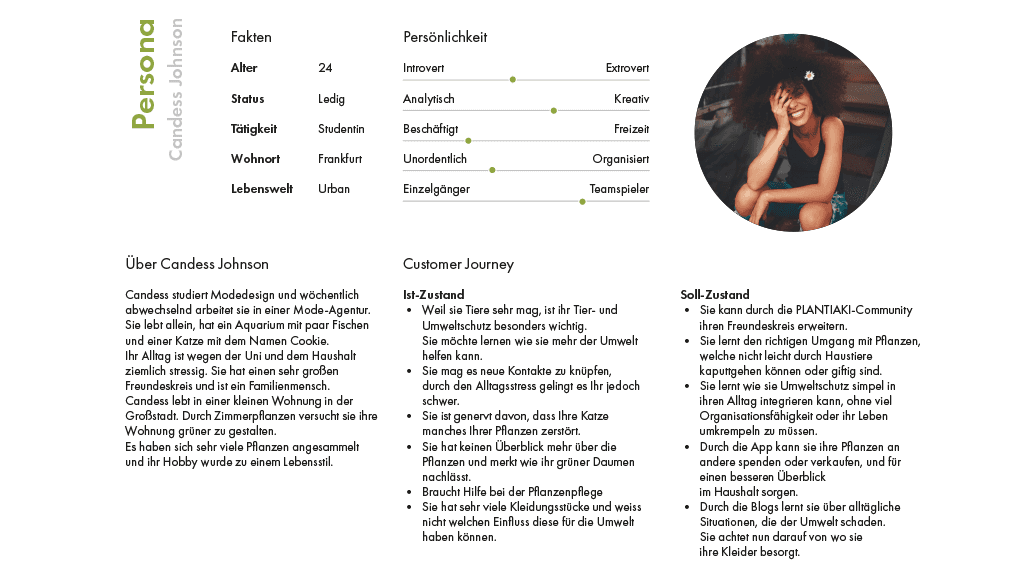
The Key Insight
Apps like Instagram and Pokémon Go have proven how powerfully well-designed digital experiences change behaviour. What if that power were directed at genuine environmental action?
Houseplant care proved to be the ideal niche: few people think of their potted plant as environmental action — yet the emotional desire for healthy, green plants is widespread. The opportunity lay precisely in that gap.
03 —AR & Concept
From Concept to Structure
Based on the insights, I developed the app's structure through wireframes and a detailed storyboard across five core areas: Community · Shop · AR Camera · Profile · Tips. The biggest design challenge in such a multi-layered app was maintaining clarity without losing depth.
Favourite feature
The Centrepiece: AR Scanning in the Plant Shop
Imagine standing in a plant shop in front of a shelf full of greenery with no idea which plant suits your home. With PLANTIAKI, you simply point your phone: the app scans the plant and shows all relevant info — care effort, light requirements, watering intervals — right there.
Buy the plant, and it's added to your profile with a tap. The same camera works in reverse: if an existing plant is struggling, the app identifies possible diseases. One feature — two use cases — one seamless experience from purchase to daily care.
04 —Design
Design Decisions
Sustainability isn't the sexiest design brief. To spark interest rather than wag a finger, I deliberately chose a modern, minimalist visual language:
- Earthy tones + whitespace — sustainability message without clichéd green
- Grotesque sans-serif typeface — timeless, trend-independent look
- Rounded corners, blurred backgrounds, leaf-shaped navigation — organic feel
- Micro-interactions — tangibly more user-friendly experience
Alongside the app, I designed matching smart devices for plant care. Their design and product photography are deliberately minimalist, so the app's design language continues in physical form.
Focus Over Feature Flood
The biggest challenge of this project wasn't design — it was strategy. I started with a very large idea (Community, Shop, Hardware, Content) and had to keep pulling myself back to what truly mattered. Working solo without a team to pump the brakes, this project meaningfully sharpened my ability to manage scope with discipline.
05 —Outcomes
Testing & Learning
I tested the prototype with around 30 participants. The clearest example: the Community section was originally designed as a pure social feed, close to Instagram. Testing revealed a different need — users didn't just want to watch and like; they wanted to act: swap plants, pass on cuttings. The social feed became a peer-to-peer plant exchange.
Impact
- Excellent grade for the bachelor thesis
- Strong, positive reception at the thesis defence
- This case study directly landed me my first job as a Product Designer
Reflection
Working solo on such a large project demands a great deal of structure and organisational skill. I started with a very large idea — in hindsight, that was exactly what was needed to truly understand the concept and ultimately distill it to what mattered. A case study doesn't need a launched product with a growth curve to have real impact — sometimes the greatest success lies somewhere entirely different from where you expected when you started.
Voices on this project
Reliable and proactive — a doer with passion and heart! I was fascinated by the professionalism and determination with which Ipek takes on her role and contributes decisively to the group's success. Her personality and authenticity enrich the work process with great joy and lightness.
Andrea Schulz
UI/UX Designer, Studienkollegin
For Ipek, a blank sheet of paper or an empty canvas is only ever a fleeting condition. No task is too complex, no requirement too high, no topic too abstract for ideas to start flowing immediately. Open to any technique or method, she is a creative free spirit with an immense degree of focus and determination. Creating something together with her, working out solutions, is always a particularly productive experience.
Frank Bauer
Senior Art Director, Wildner Designer GmbH